

14Oct3:13 pmEST
Recession Trade, Smoke 'em if You Got 'Em

As we noted with Members in last evening's full video recap, there was perhaps no greater sign of complacency from bulls not just about markets but the broad economy when it came to this morning's CPI report. Headed into the report there was a consensus brewing from equity bulls and interest rate doves that even though the main number could come in hot, the "core" CPI, backing out food and energy, was likely to come in on the cool side and assuage any fears of entrenched inflation on the rise. Essentially, their argument hinged on the notion that any inflation was due to a surge in oil and gasoline only.
Of course, both the headline and core numbers came in hot, above estimates, and way above The Fed's own 2% target, as has been the case for well over five years at this point, and running. The very notion of crude and its products, especially diesel, being contained without impacting the broader economy was always patently absurd. Diesel is at the very essence of the American economy, and will be for the foreseeable future.
However, as I write this we have TLT back in the green, as rates on the 10-Year Note are right near yesterday's lows despite surging at the open above 5.3%. Despite that, equities continue to sell off with the Nasdaq (especially semis) and small caps leading lower for a clear risk-off session.
Now, you might be wondering how that is possible. Well, despite my long-term view for higher rates, I will allow for a scenario where rates come in for a bit. But they do so as the Nasdaq, small caps, and growth stocks in general come in even harder. In other words, a classic recession trade which traps Nasdaq longs at the highs who were betting on lower rates being a cinch for the bull case.
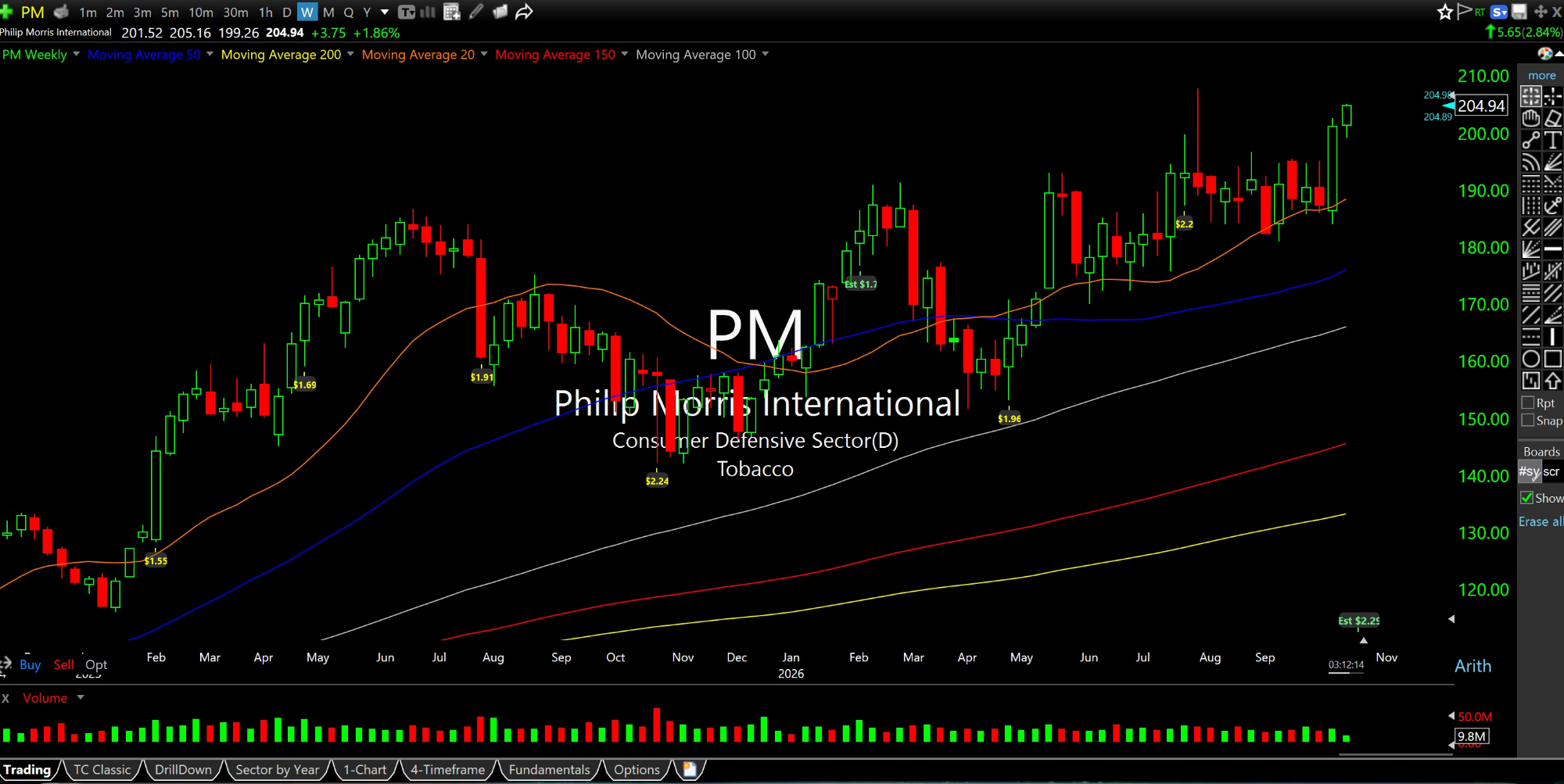
To add more credence to that view, consider the strong action in healthcare (XLV) and consumer staples (XLP) both up roughly 2% today, with a tobacco play like Philip Morris (below on the weekly chart, smoothly pushing near new highs) up nearly 3%. Again, this is classic recession action in defensive sectors, especially in light of the notable weakness in small caps, semis, and the Nasdaq overall.
As of now, the small caps in the IWM are the only major index below the 200-day moving average, which means the recession trade scenario would only be scratching the surface if it were to come to fruition. Bulls see another benign buyable dip, however, which sets up a major repricing in risk (i.e. a massive VIX spike) if it is not, in fact, business as usual this time around.